
- Quick Answer: Sciatica at a Glance
- What Sciatica Is (and What It Is Not)
- How Sciatica Shows Up in Everyday Life
- Why Sciatica Happens: Common Contributors and Drivers
- Red Flags: When Sciatica Needs Urgent Care
- How We Assess Your Sciatica
- Take The Quiz: Do You Have Sciatica
- Your Personalized Sciatica Care Plan
- What the Evidence Says, in Plain Language
- A Real-World Example: How Recovery Can Look
- Meet Your Doctor
- What Tucson Patients Are Saying
- Watch: Sciatica Explained in 5 Minutes
- Free Printable Sciatica Relief Guide
- Local, Trusted Sciatica Care in Tucson
- References and Medical Review
- Sciatica FAQs

Sciatica Treatment in Tucson: Evidence-Based, Non-Surgical Care
Content Reviewed By: Dr. Christopher Cox, D.C. on August 21, 2026
Chiropractic License Number: 7238 (NPI: 1134253172)
Table Of Contents
- Quick Answer: Sciatica at a Glance
- What Sciatica Is (and What It Is Not)
- How Sciatica Shows Up in Everyday Life
- Why Sciatica Happens: Common Contributors and Drivers
- Red Flags: When Sciatica Needs Urgent Care
- How We Assess Your Sciatica
- Take The Quiz: Do You Have Sciatica
- Your Personalized Sciatica Care Plan
- What the Evidence Says, in Plain Language
- A Real-World Example: How Recovery Can Look
- Meet Your Doctor
- What Tucson Patients Are Saying
- Watch: Sciatica Explained in 5 Minutes
- Free Printable Sciatica Relief Guide
- Local, Trusted Sciatica Care in Tucson
- References and Medical Review
- Sciatica FAQs

Quick Answer: Sciatica at a Glance
Sciatica is nerve pain that travels along the sciatic nerve, running from your lower back through the buttock and down the back of the leg. It is usually a symptom rather than a diagnosis on its own, most often caused by an irritated or compressed nerve root in the lumbar spine from a herniated disc, strain/sprain injury, spinal stenosis, or a pinched nerve in the lower back.
The good news is that most cases improve with conservative, non-surgical care, including gentle movement, targeted exercises, hands-on treatment, and time. Seek urgent medical care right away if you notice loss of bladder or bowel control, numbness around the groin or inner thighs, rapidly worsening leg weakness, or pain after a serious fall or accident.
What Sciatica Is (and What It Is Not)
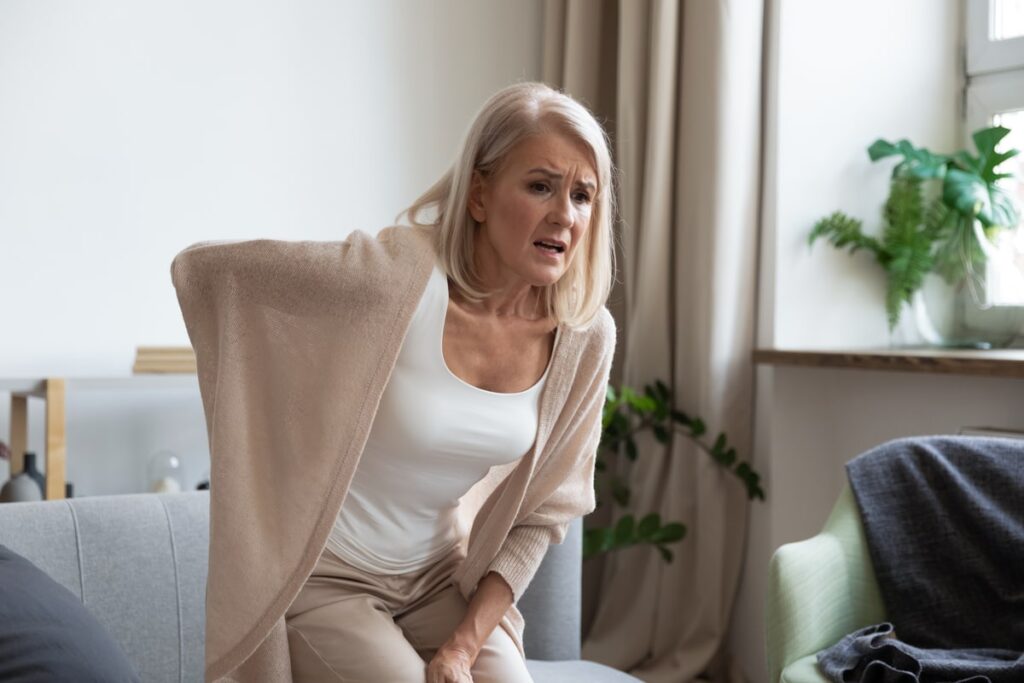
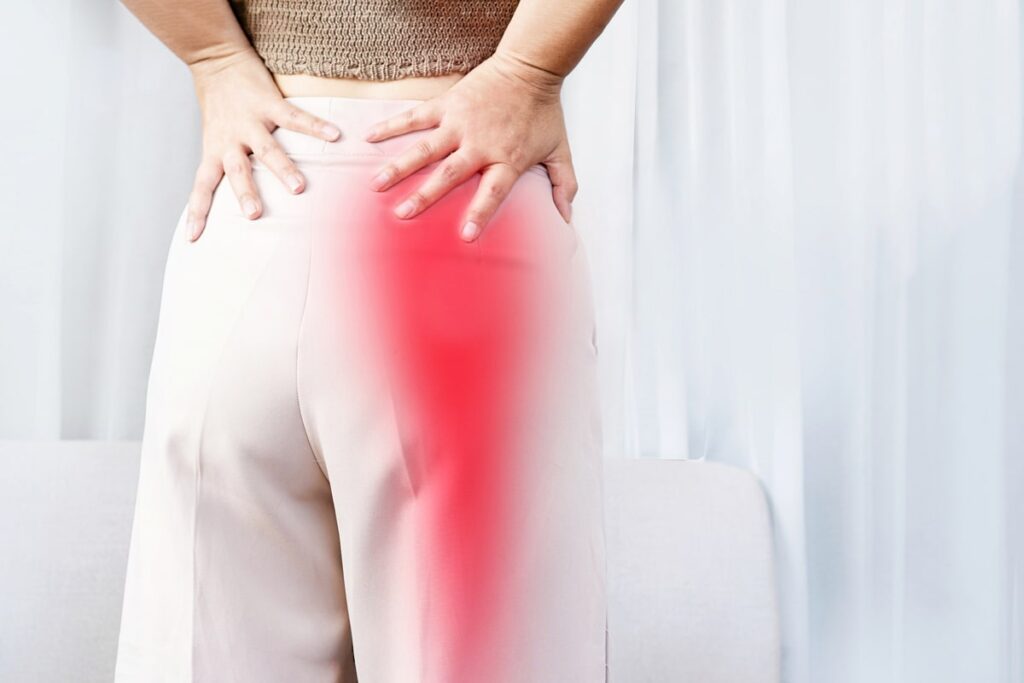
Sciatica describes a specific pattern of pain. The sciatic nerve is the longest nerve in your body, formed by nerve roots that exit the lower spine at the L4, L5, and S1 levels. When one of those nerve roots becomes compressed or inflamed, the result can be pain, numbness, tingling, or weakness that follows the nerve’s path into the buttock, thigh, calf, and sometimes the foot. True sciatica almost always involves symptoms below the knee, which is part of what separates it from ordinary lower back pain.
It helps to think of sciatica in two phases. Acute sciatica comes on over days or weeks and, for many people, settles meaningfully within six to twelve weeks with the right care and activity. Persistent sciatica lingers longer or keeps returning, which usually points to an underlying driver that needs to be identified and addressed rather than simply waited out.
Two myths are worth clearing up. The first is that sciatica means surgery is inevitable. In reality, the majority of cases respond to non-surgical care, and surgery is generally reserved for specific situations such as progressive nerve deficits or symptoms that do not respond to a fair trial of conservative treatment. The second myth is that bed rest is the cure. Prolonged rest tends to slow recovery. Gentle, guided movement is usually part of getting better, not something to avoid.
Why Sciatica Happens: Common Contributors and Drivers
When patients ask “why me?”, the honest answer is that sciatica usually has more than one contributor. We look at three categories together.
Mechanical and structural factors. These are the physical sources of nerve irritation: a herniated or bulging disc pressing on a nerve root, lumbar spinal stenosis (a narrowing of the spaces the nerves travel through), degenerative disc changes, bone spurs, spondylolisthesis (a forward slip of one vertebra), and in some cases involvement of the piriformis muscle deep in the buttock.
Load and lifestyle factors. How you move and live matters. Long hours of sitting, repetitive bending and lifting, a sudden jump in activity, a sedentary routine, extra body weight, smoking (which affects disc health), and poor sleep or high stress can all raise the odds of a flare or slow your recovery.
A capacity and recovery mismatch. Often the real issue is that the demand placed on your lower back and the nerve outpaces what those tissues can currently tolerate. Identifying that gap, then closing it with the right mix of rest, movement, and progressive loading, is central to lasting relief rather than a temporary fix.
Red Flags: When Sciatica Needs Urgent Care
Most sciatica is not dangerous, but a small number of symptoms can signal a serious problem that needs prompt medical attention. Do not wait to see how things go if you experience any of the following.
Go to an emergency department or call for urgent medical help right away if you have:
- Loss of bladder or bowel control, or new difficulty starting or stopping urination
- Numbness or tingling around the groin, buttocks, or inner thighs (sometimes called saddle numbness)
- Severe or rapidly worsening weakness in one or both legs
- Sciatica symptoms in both legs at the same time
- Back or leg pain following a significant fall, car accident, or other major trauma
Contact your physician promptly, even without those emergencies, if your pain is accompanied by unexplained fever, unexplained weight loss, a history of cancer, or a weakened immune system. These signs do not mean something serious is definitely happening, but they do mean the situation should be evaluated medically before starting conservative care. Staying true to our approach, if your case calls for a different kind of provider, we will tell you and help point you in the right direction.
How We Assess Your Sciatica
A good plan starts with a clear picture of what is actually driving your symptoms. Our assessment has three parts.
First, we take a thorough history. We want to understand when your symptoms started, how they behave throughout the day, what makes them better or worse, whether you have had episodes before, and whether any red flags are present. Many patients tell us this is the most detailed conversation about their pain they have ever had.
Second, we perform a focused physical examination. This typically includes a neurological screen of your reflexes, muscle strength, and sensation to see whether a specific nerve root is involved, along with orthopedic tests such as the straight leg raise and slump test that help reproduce and localize the problem. We also look at how you move, stand, and walk.
Third, we work through a differential diagnosis. Leg pain can come from a disc-related nerve compression, spinal stenosis, the piriformis muscle, the sacroiliac joint, the hip, or occasionally other sources. Sorting between these possibilities is what lets us target care instead of guessing.
A note on imaging. For typical sciatica without red flags, guidelines advise against routine X-rays or MRI in the early weeks, because imaging often shows changes that are common and unrelated to your pain and does not usually change first-line treatment. We refer for imaging when it will genuinely change the plan, such as when red flags are present, when there is a progressive neurological deficit, or when symptoms are not improving as expected.
Take The Quiz!
Your Personalized Sciatica Care Plan
There is no single recipe for sciatica, so we build a phased plan around your exam findings, your goals, and your response to care. Most plans move through four phases, and we adjust the pace based on how you progress.
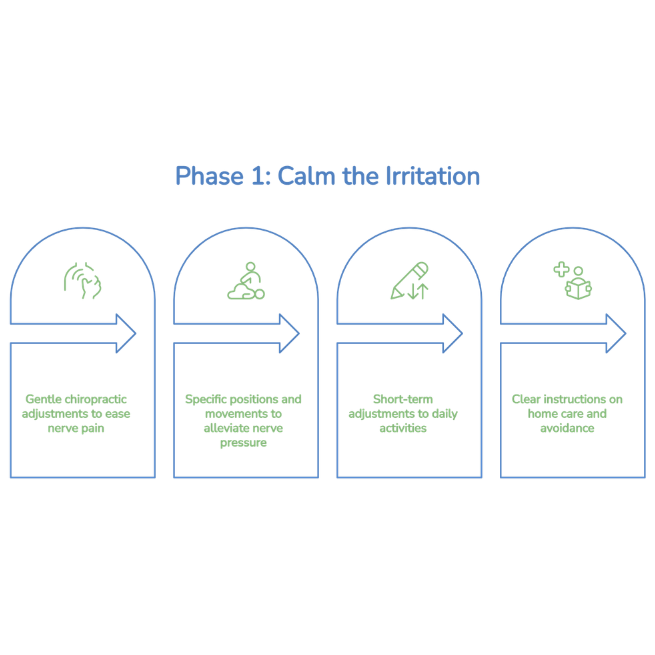
Phase 1: Calm the irritation. The first priority is reducing nerve sensitivity and pain so you can move and sleep again. This phase often includes gentle, specific chiropractic adjustments, positions and movements that relieve pressure on the nerve, short-term activity modification, and clear education about what to do and what to avoid at home.
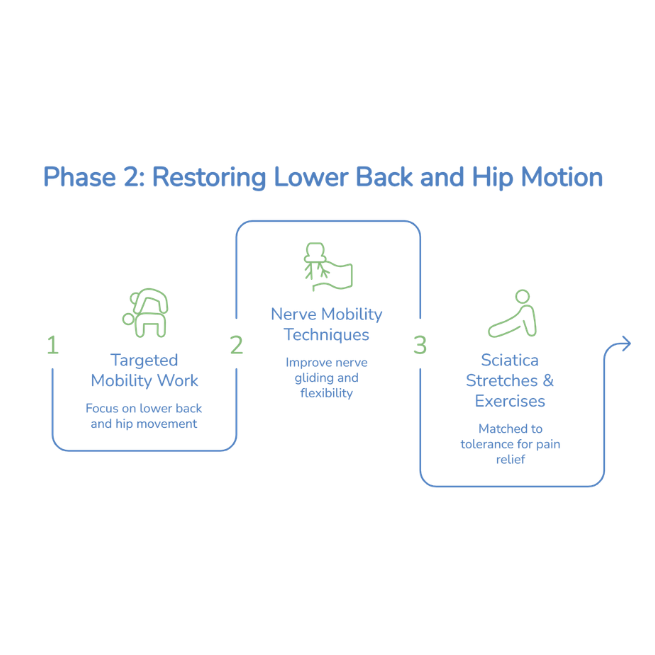
Phase 2: Restore motion. As pain settles, we work to restore comfortable movement in the lower back and hips and to improve how freely the nerve glides. This commonly includes targeted mobility work, nerve mobility techniques, and a starter set of sciatica stretches and exercises matched to your tolerance.
Phase 3: Rebuild capacity. Lasting relief comes from making your lower back and hips more resilient. In this phase we add progressive strengthening for the core, glutes, and hips, along with movement and posture retraining, so your body can handle the demands of daily life without flaring.

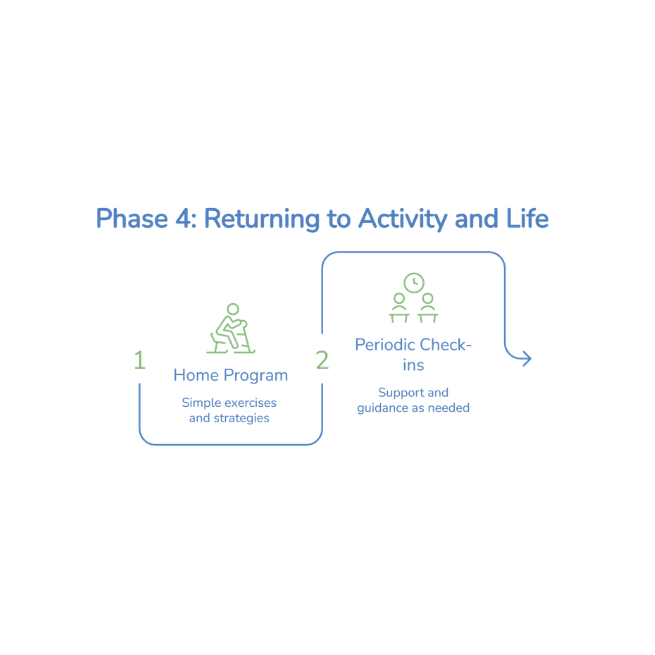
Phase 4: Return to activity and life. The final phase is about getting you back to work, exercise, and the activities you love with confidence, then keeping you there. We finish with a simple home program and a relapse-prevention strategy, plus periodic check-ins if helpful.
Indication-based support technologies. When the exam supports it, we may add spinal decompression therapy to gently offload the disc and reduce pressure on the nerve, or shockwave therapy to address associated soft-tissue irritation. These tools are used to complement hands-on care and rehabilitation, not to replace them.
A clinical note worth stating plainly: not every modality is right for every case. The right plan is the one your specific findings call for, and we will only recommend a treatment or technology when there is a clear reason it fits your situation.
What the Evidence Says, in Plain Language
We believe you deserve to know what the research supports and where it is uncertain. Here is an honest snapshot.
- National clinical guideline (American College of Physicians, 2017). This guideline for low back pain recommends starting with non-drug treatments such as exercise and spinal manipulation before reaching for medication. It applies broadly to acute, subacute, and chronic low back pain in adults. Limitation: it addresses low back pain in general rather than sciatica specifically, and the certainty of evidence ranged from low to moderate.
- National guideline (NICE, United Kingdom, 2016, updated 2020). This guidance on low back pain and sciatica recommends staying active, structured exercise programs, and manual therapy delivered as part of a package that includes exercise. It applies to people aged 16 and older. Limitation: manual therapy is endorsed alongside exercise rather than on its own, and recommendations are based on grouped evidence.
- Systematic reviews of spinal manipulative therapy. Pooled research suggests spinal manipulation can produce small to modest improvements in pain and function, comparable to other recommended therapies, and is generally safe, with side effects that are usually mild and short-lived. Applies to many adults with low back pain, including some with related leg symptoms. Limitation: average effect sizes are small and studies vary in quality.
- Network meta-analysis of sciatica management (Lewis and colleagues, 2015). This review compared several strategies for sciatica and found that a number of non-surgical approaches can help. Applies to adults with sciatica from nerve root involvement. Limitation: many included trials were small or of lower quality, so conclusions carry real uncertainty.
- Evidence on spinal decompression and traction. Some patients with disc-related nerve pain report meaningful relief with decompression, and it is commonly used as an adjunct. Applies to selected cases of disc-related radicular pain. Limitation: high-quality evidence is limited, certainty is low, and it is best viewed as one part of a broader plan rather than a stand-alone cure.
Taken together, the research supports an active, conservative, non-surgical approach as a reasonable first step for most people, while being clear that no single treatment works for everyone.

A Real-World Example: How Recovery Can Look
The following is a de-identified, composite example created for illustration. It is not a specific patient, and individual results vary.
Patient profile. A 52-year-old office worker from the Oro Valley area, otherwise healthy, with about six weeks of left-sided shooting pain running from the lower back into the back of the leg.
Baseline limitations. Could not sit longer than fifteen minutes without sharp pain, was sleeping poorly because of night discomfort, and had stopped a regular morning walking routine.
Assessment findings. A positive straight leg raise on the left, reduced sensation along the outer lower leg consistent with L5 involvement, no muscle wasting, and no red flags. Imaging was not needed to begin care.
Plan duration. Roughly eight to ten weeks of phased care.
Interventions used. Gentle chiropractic adjustments, nerve mobility work, spinal decompression to offload the irritated segment, a progressive home exercise program for the core and hips, and simple ergonomic changes at the desk.
Milestones. By Week 2, night pain had eased and sleep improved. By Week 4, sitting tolerance reached about 45 minutes and the morning walk resumed. By Week 8 and beyond, a return to the gym with minimal symptoms.
Outcome measures. Pain dropped from about 7 out of 10 to 1 or 2 out of 10, sitting and walking tolerance returned, daily activities resumed, and confidence in the back was restored.
Maintenance plan. A short daily home program plus occasional check-in visits to protect the progress and catch any early flare.

Meet the Team





What Our Patients are Saying
Local, Trusted Sciatica Care in Tucson
If sciatica is keeping you from sitting comfortably, sleeping well, or doing the things you love, you do not have to keep pushing through it. Patients across Tucson, Vail, Oro Valley, and the surrounding communities choose Life Aligned Wellness Center for an honest assessment and a non-surgical plan built around their goals.
What your first visit looks like. You will start with a one-on-one consultation and a thorough assessment so we can understand exactly what you are dealing with. From there, we set a clear starting point, explain your options, and, when appropriate, begin care right away. As an out-of-network provider, we offer customized care plans and flexible payment options, including financing, so the path to relief is clear from the start.
Ready when you are.
- Schedule Your Consultation
- Call us: (520) 731-9595
- Visit: 7290 E Broadway Blvd Ste. 124, Tucson, AZ 85710
And true to how we practice, if we are not the right fit for your case, we will tell you and help point you toward who can help.
Sciatica Explained: What It Is, Why It Happens, and What Actually Helps
Video summary: In this short video, we walk through what sciatica really is, why the pain travels from the lower back down the leg, and the most common drivers we see in practice. We cover the symptoms to watch for, the small set of red flags that call for urgent medical care, and the step-by-step way we assess each case before recommending any treatment. Finally, we explain how a phased, non-surgical plan helps calm the irritation, restore movement, and rebuild strength so you can get back to the activities you enjoy.
Free Printable Sciatica Relief Guide
Want a simple plan you can keep on the fridge or take to work? Our free Sciatica Relief Guide puts the essentials in one place so you can start moving in the right direction today.
Inside the guide you will find a plain-language overview of sciatica, the red flags that mean you should seek care, gentle starter stretches and positions of relief, sitting and workstation tips for flare-prone days, and clear guidance on when it is time to get assessed.
Download the Free Sciatica Relief Guide
References and Medical Review
References
- Qaseem A, Wilt TJ, McLean RM, Forciea MA; Clinical Guidelines Committee of the American College of Physicians. Noninvasive Treatments for Acute, Subacute, and Chronic Low Back Pain: A Clinical Practice Guideline From the American College of Physicians. Annals of Internal Medicine. 2017.
- National Institute for Health and Care Excellence (NICE). Low back pain and sciatica in over 16s: assessment and management. NICE Guideline NG59. 2016, updated 2020.
- Rubinstein SM, et al. Spinal manipulative therapy for chronic low-back pain. Cochrane Database of Systematic Reviews.
- Lewis RA, et al. Comparative clinical effectiveness of management strategies for sciatica: systematic review and network meta-analyses. The Spine Journal. 2015.
- Coulter ID, et al. Manipulation and Mobilization for Treating Chronic Low Back Pain: A Systematic Review and Meta-Analysis. The Spine Journal. 2018.
This page is intended for general education and does not replace personalized medical advice. If you have concerning symptoms, please seek care from a qualified provider.
Sciatica FAQs
Content Reviewed By: Dr. Christopher Cox, D.C. on August 21, 2026
Chiropractic License Number: 7238 (NPI: 1134253172)