
Date: November 12, 2026

Walk Comfortably Again After a Dashboard Knee Injury
Your knee slammed into the dash, you iced it that night, and the swelling went down by the weekend. Three weeks later, stairs still feel wrong and the knee aches every time you sit in a car. A dashboard knee injury is one of the most underestimated results of a front end collision, largely because the knee bends fine afterward and people assume that means it is fine. It is not that simple. The same impact that bruised the kneecap also drove force up through the thigh into the hip and pelvis, and it may have stressed ligaments that do not announce themselves right away. This post covers what takes the hit, what the delayed symptoms look like, and how we evaluate knee pain after a car accident in Tucson.
What Actually Happens to the Knee in a Dashboard Impact
In a frontal collision, your lower leg stops when it meets the dash while your thigh and torso keep moving forward. The knee sits directly in the middle of that mismatch, which is why it absorbs so much of the load.
The force does not stop at the kneecap. It travels up the femur and into the hip socket, and it can shear the shin bone backward relative to the thigh. That backward shear is the classic mechanism for a posterior cruciate ligament injury, sometimes called a dashboard injury for exactly that reason.
How you are restrained changes how much of that force reaches the knee. NHTSA vehicle safety guidance describes airbags as supplemental restraints designed to work with seat belts rather than replace them, and some vehicles add a knee airbag specifically to spread this load.
Structures most often involved:
- Patella, including bruising, cartilage damage, and fracture
- Posterior cruciate ligament, from the shin being driven backward
- Meniscus, from compression combined with rotation
- Quadriceps tendon and patellar tendon
- Hip joint and acetabulum, when force travels the full length of the femur
Five Symptoms of a Dashboard Knee Injury Worth Getting Checked
Bruising fades quickly, which is why people stop paying attention. The symptoms that matter most tend to show up once you start moving normally again.
- A vague sense of instability, especially going down stairs or stepping off a curb
- Aching behind the kneecap that worsens after sitting for a while
- Swelling that keeps returning after activity, even weeks later
- Difficulty kneeling or putting weight through a bent knee
- Hip or groin pain on the same side, which points to force that traveled up the chain
Consider a straightforward example. A Tucson driver rear ends a stopped car at low speed on Speedway, hits the knee, and returns to work the next day. Two months later she cannot hike Sabino Canyon without the knee swelling by evening. Nothing new happened. The original injury simply never rehabbed, and the leg quietly changed how it loads.
Why Knee Pain After a Car Accident Is Often Not Just a Knee Problem
This is the part most people miss, and it is the core of how we approach every knee we see. Your knee is a hinge caught between two mobile joints, the hip above and the ankle below. When either of those stops moving well, the knee absorbs the difference.
A dashboard impact disturbs that chain in two ways. The impact itself can stress the hip, and the weeks of limping afterward teach the body new movement habits that outlast the original injury.
So when we assess a knee after a crash, we look at:
- Foot mechanics and how the arch loads during walking
- Ankle mobility, especially the ability to bring the shin forward over the foot
- Hip strength, particularly the glutes that control the thigh
- Pelvic alignment and lumbar spine motion
- Neuromuscular patterns, meaning the timing of how muscles fire
Our knee pain treatment in Tucson page goes deeper on this whole person framework, and our post on why knees hurt covers the non crash versions of the same patterns.

When a Knee Injury After a Crash Needs Urgent Imaging
Conservative care is the right first step for many crash knees, and it is the wrong first step for a few. We would rather refer you out than delay a diagnosis.
Any of these warrant urgent evaluation rather than an appointment next week.
How We Evaluate and Treat Dashboard Knee Injuries in Tucson, AZ
We begin with the crash itself, because mechanism predicts injury. Which knee hit, how far the seat was from the dash, whether your foot was on the brake, and whether you have limped since all shape the exam.
A typical plan includes:
- A chain based exam from foot to lumbar spine, not just the painful joint
- Joint mobilization and adjustments where motion is restricted, often at the ankle, hip, and pelvis
- Soft tissue work for the quadriceps, hamstrings, and calf that have been guarding
- Graded rehab that rebuilds control first, then strength, then load tolerance
- Referral for imaging or orthopedic consultation when findings suggest a ligament tear or fracture
If your crash also produced neck or back symptoms, our whiplash and auto accident treatment in Tucson page explains how we handle multiple injury sites in one plan rather than in separate silos.
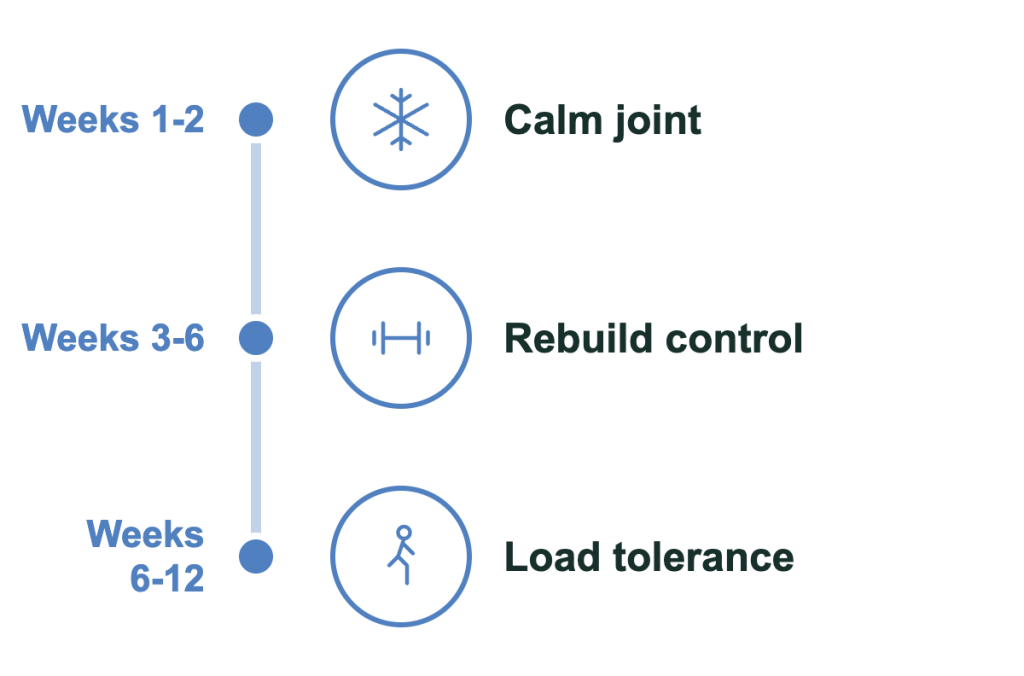
What Recovery Looks Like, and Why Waiting Costs You
Results vary based on crash severity, what was injured, and how long the knee has been compensating. A general arc still helps.
- Weeks one and two. Calm the joint, restore straightening, protect without immobilizing.
- Weeks three to six. Rebuild quadriceps and glute control, restore ankle and hip motion.
- Weeks six to twelve. Load tolerance, stairs, hiking, and return to sport or to physical work.
The cost of waiting is not usually dramatic. It is that a knee compensating for six months teaches the hip and low back to compensate too, and by then you are unwinding three problems instead of one.
Where This Leaves You
A knee that bends without pain is not the same as a knee that is uninjured. The dashboard delivers force in a direction the knee is least built to handle, and it sends the rest of that force up into the hip and pelvis where the effects show up later as stiffness, swelling, or a leg that just feels unreliable. Assessing the whole chain early is what keeps a single bruised knee from becoming a hip and low back problem by spring. If your knee has not felt right since the crash, book a knee evaluation in Tucson and let us look at the whole leg rather than the sore spot.
Frequently Asked Questions
How long after a crash can knee symptoms still appear?
Symptoms commonly surface within the first two weeks, but stiffness, swelling with activity, and instability can appear a month or more later once you return to normal walking loads. A delayed onset does not mean the injury is unrelated to the crash, though documentation becomes more important the longer you wait.
Does an airbag deployment change the risk to the knee?
It can. Airbags slow the torso, which changes how much force the lower leg absorbs, and some vehicles include knee airbags specifically to spread that load. Deployment does not guarantee the knee was protected, especially if the seat was positioned close to the dash.
Can I keep walking and running while the knee heals?
Walking is usually encouraged early, since motion helps joints recover. Running is different, because it loads the knee at several times body weight and often reinforces the compensation pattern. Most people return to running in stages once single leg control and pain free stairs are restored.